
Refresher Training
that keeps Competence Alive
Wind Turbine Training is not a one-off event. Our digital refresher modules keep technical knowledge accurate, accessible and ready to use, long after the course has ended.
Your team completes a training program. They return to site motivated, confident and full of new knowledge. Six weeks later, how much of it is still there?
For most organizations, the honest answer is uncomfortable. Not because the training was poor, and not because the technicians were inattentive, but because forgetting is what the human brain does by default. Unless knowledge is revisited, it fades.
dwpa Refresher Training is designed to solve exactly that problem.
The Refresher Training are short, focused, interactive digital modules that reinforce the most important concepts from your technical training programs at the moments when memory needs support the most. They are delivered through our digital learning platform, and are available as a supplement to selected dwpa programs.
The result is a workforce that does not just attend training, but retains it.
What is Refresher Training?
Refresher Training modules are compact digital learning units that revisit the core content of a technical training program. Each module concentrates on a defined subject area and is built to be completed in a short, focused session that fits realistically into a working week.
Rather than repeating an entire course, a refresher module isolates what matters most: the principles technicians rely on when diagnosing a fault, the safety knowledge that must never be uncertain, and the practical techniques that separate a confident troubleshooter from a cautious one.
Each module combines several learning formats.
- Interactive exercises: learners click, explore, simulate and engage rather than passively watching content
- Real-life scenarios: concepts explained through situations technicians actually meet in the field
- Short videos: visual explanation of components, systems and procedures
- Printable material: worksheets and reference documents that can be taken to the turbine
- Knowledge checks: active recall exercises that strengthen memory far more effectively than re-reading
Modules are grouped into chapters, so an organization can assign an entire subject area or target a single topic where a competence gap has been identified.
Why Refresher Training is necessary
The forgetting curve is not a training problem, it is a human one
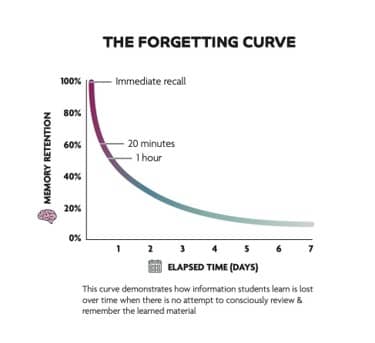
In 1885, Hermann Ebbinghaus demonstrated that memory decays exponentially when no effort is made to retain it. His findings have been replicated consistently ever since, and the pattern is remarkably steep:
- Within 20 minutes, a significant share of new information is already gone
- Within 24 hours, roughly two-thirds of course content has faded
- After 30 days, only a small fraction of the original material remains reliably accessible
This is not a flaw in the learner and not a flaw in the course. The brain removes information it judges to be unimportant or rarely accessed. Understanding a concept in the classroom helps encode it, but understanding alone does not protect it from decay.
What this Costs a Wind Farm
- Faults that are diagnosed by replacement rather than by reasoning
- Repeat callouts on issues that should have been resolved first time
- Longer downtime while technicians rebuild knowledge they already had
- Errors traced back to forgotten basics rather than missing skills
- Hesitation in safety-critical situations where certainty is essential
How Refresher Training change the curve
The forgetting curve can be interrupted. Decades of cognitive research point to three mechanisms that work, and dwpa Refresher Training modules are built around all three:
1. Spaced repetition
Reviewing material at expanding intervals moves knowledge from short-term into stable long-term memory. Each repetition resets the decay and flattens the curve.
2. Active retrieval
Forcing the brain to pull information out through questions, simulations, and problem-solving, builds far stronger neural pathways than passively reviewing notes.
3. Early intervention
The first review is the most valuable one. Reinforcement soon after training prevents the immediate collapse in retention that otherwise happens within days.
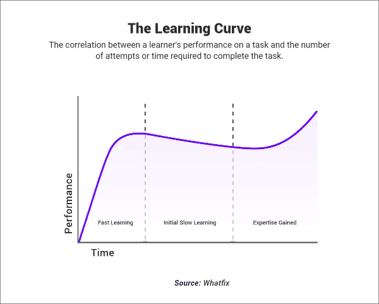
Plotted over time, the effect is clear. Knowledge climbs steeply during a five-day training programme, then begins to fall away. Each refresher module pushes retention back up. After several spaced refreshers, the baseline settles far higher than it would have without them, and stays there.
What Refresher Training delivers
-
Reinforces the concepts that matter the most
Short, focused modules revisit core principles so that critical knowledge does not quietly fade between training events. -
Builds long-term retention
Repetition strengthens memory pathways. These modules apply that principle in a format technicians will actually use. -
Supports continuous skill growth
Technicians build on what they already know instead of relearning from scratch, which raises both confidence and competence over time.
-
Keeps safety and troubleshooting knowledge active
The knowledge with the highest consequence is the knowledge that must stay sharpest. -
Reduces errors caused by forgotten fundamentals
Fewer misdiagnoses, fewer unnecessary component swaps, fewer repeat visits. -
Maintains field performance between programs
Competence is sustained through the months when no formal training is scheduled.
Available Now - HYDRAULIC Refresher Modules
The first Refresher Modules covers Hydraulics; one of the most fault-prone and diagnostically demanding systems on a modern wind turbine, and consistently one of the areas where competence gaps have the greatest operational impact.
The Hydraulic Modules reinforces the concepts technicians depend on in the field.
Each topic is supported by new technical visuals, practical examples and interactive elements developed specifically for digital delivery.
- Hydraulic principles and system behaviour
- Valves and valve function
- Sensors and measurement
- Accumulators
- Reading and interpreting hydraulic diagrams
- Systematic fault-finding logic
- Safe working practice in hydraulic systems
Refresher Training coming in 2026-2027
- Hydraulic - Available Now
- Controls - September 2026
- Electrics - November 2026
- Mechanical - December 2026
- Together these will form a complete digital reinforcement layer beneath dwpa's technical training portfolio, supporting technicians across every major turbine system.
How Refresher Training fits your Competency Plan
Refresher modules are most powerful when they are not treated as standalone content, but as one component of a structured competency journey.
Refresher modules can also be used as pre-study material before a classroom program, so participants arrive with a shared baseline and Trainer time is spent on depth rather than on levelling the room.
- Assess - establish where your technicians actually stand today through technical competency assessment
- Train - deliver targeted technical programmes, on-site, in classroom or remote/live-virtual
- Reinforce - sustain the investment with spaced digital refreshers
- Re-assess - measure retention and identify where further support is needed
FAQ
How long does a refresher module take to complete?
Modules are deliberately short and focused so they fit into a normal working week without disrupting site operations. Content is organised into chapters, allowing learners to complete a meaningful unit in a single sitting.
Who is refresher training for?
Technicians who have completed technical training and need to maintain that competence over time, and organisations that want their training investment to hold its value beyond the final day of a course.
Do participants need to have attended a dwpa course first?
Refresher modules are designed to reinforce selected dwpa programmes and are most effective when they follow formal training. They can also be used as pre-study material ahead of a course.
Is this the same as standard e-learning?
No. These modules are interactive rather than passive. Learners explore, simulate, answer and apply — because active retrieval is what actually protects memory. Passive video watching does not.
How often should refreshers be completed?
Spaced repetition works best at expanding intervals. We help you design a schedule that matches your operational rhythm and your competency objectives.
Can refresher access be provided for a whole team?
Yes. Access can be arranged at individual or team level. Contact us to discuss the option that fits your organisation.
Which turbine types does the content cover?
Refresher content focuses on the underlying technical systems and principles, which apply across platforms. For platform-specific training, see our supported wind turbines.
Protect the training you have already invested in
Every course your organization attends represents a real investment in time.
Refresher training is what ensures that, that investment is still working six months later.
Talk to us about adding digital refresher modules to your competency plan.
Looking for tailored training or expert guidance?
Let's talk about your objectives and how we can help you achieve them.
