
Best Training Programs for Enhancing Wind
Operational Performance
The global wind energy sector is expanding at an unprecedented pace. As turbine fleets grow more complex and the pressure to maximize uptime intensifies, the quality of the people operating and maintaining those assets has never mattered more. At the heart of this challenge sits a question every wind farm operator must answer: how do you build a workforce capable of delivering consistently high performance?
For over two decades, Danish Wind Power Academy (dwpa) has been answering that question for wind energy organizations worldwide. With more than 20 years of hands-on industry experience, dwpa has become one of the most trusted names in wind turbine training, combining global best practices with turbine-specific expertise to deliver programs that generate measurable results on the ground.
Rather than offering generic technical instruction, dwpa takes a consultative, end-to-end approach. Every engagement begins with an assessment of the client’s current competency levels, followed by a customized training plan, structured delivery either on-site, in a classroom, or via remote live-virtual methods, and ongoing assessment and optimization. The goal is not merely to teach but to embed knowledge that translates directly into safer operations, reduced downtime, and stronger financial performance across wind assets.
dwpa’s impact is best illustrated by the testimony of those who have worked with it. Matt McCabe, President and CEO of Sequitur Renewables, notes that at the wind farm where dwpa’s training was most closely applied, production in certain months doubled or even tripled year-over-year. A result he attributes directly to investment in people.
A 360-Degree Approach to Operational Training
What distinguishes dwpa from other providers is the breadth of its program portfolio. Rather than focusing solely on field technicians, dwpa has designed training pathways for every role that influences operational performance; from apprentice technicians to experienced troubleshooters, from remote operations staff to senior management and leadership teams. Its suite of programs falls into several interconnected categories.
Core Training Programs
1. Technical Competency Assessment
Before any training begins, dwpa recommends its Technical Competency Assessment tool. This assessment gives operators a precise understanding of individual and team knowledge gaps across five core areas: Controls, Electrics, Gearbox, Hydraulics, and Mechanicals.
The value is twofold. First, it ensures technicians attend programs suited to their actual skill level rather than wasting time on content they have already mastered. Second, it enables operations managers to make informed decisions about training investment, targeting resources where the performance gap is greatest.
James Beevor, Operations Manager at RWE Renewables UK, describes the assessment as providing a clear route forward, noting that it gives both individuals and managers a thorough overview and a concrete path to closing identified competency gaps.
2. Advanced Component Theory (ACT)
The Advanced Component Theory program (ACT) is designed for anyone who needs a strong foundational understanding of wind turbine technology. Delivered over five days, it covers generic wind turbine systems and sub-systems down to component level, including an introduction to technical documentation such as electrical schematic and hydraulic diagrams. The program includes both individual and group interactive exercises, culminating in a formal assessment.
It is available for delivery either in-person or via dwpa’s remote live-virtual format, making it accessible to teams across geographies.
SSE Renewables has chosen this program for its apprentices at the Greater Gabbard offshore wind farm, specifically for its practical tools, hands-on exercises, and its contribution to improved internal collaboration and cross-functional understanding.
3. Technical Sprints
Where the full ACT program addresses broad competency development, Technical Sprints are highly targeted interventions. Developed as a direct follow-up to the competency assessment, they allow organizations to address specific knowledge deficits in Controls, Hydraulics, Mechanicals, Gearbox, or Electrics without requiring technicians to repeat content they already know well.
These short, focused programs are delivered entirely online, making them well-suited to teams with operational constraints on availability and scheduling.
4. Advanced Platform Theory (APT)
The Advanced Platform Theory (APT) program represents dwpa’s most intensive theoretical offering. It is a turbine type-specific course, meaning the content is customized to the exact platform a technician works on; delivered intensively over five days. It provides deep awareness of all turbine systems and sub-systems, using actual performance data and real fault scenarios to ground the learning in practical reality.
APT is designed for experienced technicians or technical support staff who need to fully understand key system failures and develop the deep contextual knowledge required for advanced troubleshooting roles.
Lærke Rau, Competency Management Lead at Ørsted, describes the APT program not just as a course but as an investment in performance; one that has produced stronger and more independent technical staff, a greater focus on preventive maintenance, and better conditions for stable, high-performance operations.
The program can be delivered in-person or via dwpa’s distance learning model.
5. Wind Turbine Maintenance Training
Preventive maintenance is the single most effective lever for improving turbine uptime and reducing long-term asset costs. Yet it is often undermined by technicians who understand what to do without understanding why. dwpa’s Wind Turbine Maintenance Training addresses this directly.
This turbine-specific, in-person course is delivered on the actual turbine type participants will be maintaining, ensuring that the link between theory and practice is immediate and tangible. It is recommended that participants complete the Advanced Platform Theory course beforehand to ensure sufficient underpinning knowledge. The program is relevant not only for field technicians but also for supervisors and technical support staff involved in overseeing maintenance activities.
6. Wind Turbine Troubleshooting Training
When turbines trip, fail, or underperform, the ability to diagnose and resolve faults quickly is a direct driver of energy production and revenue. dwpa’s Wind Turbine Troubleshooting Training builds on the platform-specific theory delivered in the APT program and focuses on developing robust, replicable troubleshooting methodologies.
The course is delivered in-person on the specific turbine type involved, giving participants the opportunity to apply techniques in authentic working conditions. It is targeted at both field-based technicians undertaking advanced troubleshooting and off-site support resources who provide technical guidance to field teams.
7. Maintenance Quality Inspection Training (MQI)
As wind farm portfolios grow, ensuring consistent maintenance quality across multiple sites and contractors becomes a critical management challenge. dwpa’s MQI program is designed to equip supervisors, managers, and off-site technical resources with a deep understanding of preventive maintenance activities; specifically, what poor-quality execution looks like and what its consequences are for turbine longevity and performance.
This in-person course combines classroom theory with direct in-turbine practical exercises, making it an effective tool for quality assurance leads, technical managers, and anyone responsible for verifying maintenance standards.
8. Installation Quality Inspection Training (IQI)
For organizations involved in turbine installation activities, IQI training addresses a different but equally important dimension of quality. The program covers installation procedures, safety requirements, common errors, and the critical checkpoints that determine whether a new installation will perform reliably from day one. Participants develop skills in evaluating completed installations and compiling snag lists that drive continuous improvement in installation practices.
9. End of Warranty Inspection Training (EOW)
The transition from a manufacturer’s warranty period to owner-operator responsibility is one of the highest risk moments in a wind turbine’s lifecycle. dwpa’s End of Warranty Inspection Training prepares technicians, engineers, and quality inspectors to evaluate turbine condition systematically at this critical juncture, identifying deviations, building substantiated claims lists, and ensuring that the asset is in an appropriate condition for continued production.
The program also reviews logged performance data from the warranty period, providing a comprehensive picture of how the turbine has been performing and what actions are needed going forward.
10. Gearbox Maintenance and Inspection Training (GMI)
The gearbox is one of the most expensive components in a wind turbine and one of the most common sources of unplanned downtime. dwpa’s GMI program covers fundamental gearbox design and operational principles, common failure modes, maintenance best practices, and detailed guidance on conducting gearbox inspections.
Delivered in person at a purpose-built facility that allows participants to gain direct, hands-on inspection experience, this program is relevant for anyone conducting gearbox inspections or responsible for interpreting inspection reports and making asset management decisions.
11. Remote Operation Center Training
As wind farms become increasingly monitored and managed from centralized remote operations centers, the competency of the staff working in those centers has a direct bearing on operational performance. dwpa’s Remote Operation Center Training provides a thorough grounding in wind turbine systems and the specific ways those systems are affected by remote operation and control.
This program is available in both in-person and remote distance learning formats, making it accessible to operations center teams regardless of their location.
12. Operation and Maintenance Awareness Training
Rounding out dwpa’s portfolio, the O&M Awareness program provides a comprehensive overview of current best practice across all elements of wind farm operation and maintenance. It is designed for anyone directly involved in or supporting the delivery of O&M activities and is equally valuable as a refresher for experienced practitioners and an orientation for those new to wind energy operations.
Delivery options include on-site or remote virtual learning, and dwpa also offers tailored variants of this program for management and leadership teams, ensuring that decision-makers have the operational literacy to drive effective strategies.
Multi-Brand Turbine Coverage
One of dwpa’s most practically valuable attributes is the breadth of its turbine-specific expertise. The academy supports training across the majority of turbine platforms in operation globally, including Vestas, Siemens Gamesa, GE Renewable Energy, Nordex Acciona, NEG Micon, Senvion, Gamesa, Suzlon, and Bonus Energy, as well as a range of other turbine types.
This matters because real-world wind farms are rarely single-brand environments. Portfolio operators managing mixed fleets need a training partner who can deliver consistent, high-quality instruction across all their assets and dwpa is continuously expanding the range of platforms it covers.
Flexible Delivery for Operational Realities
Build training around your workforce, not around logistics
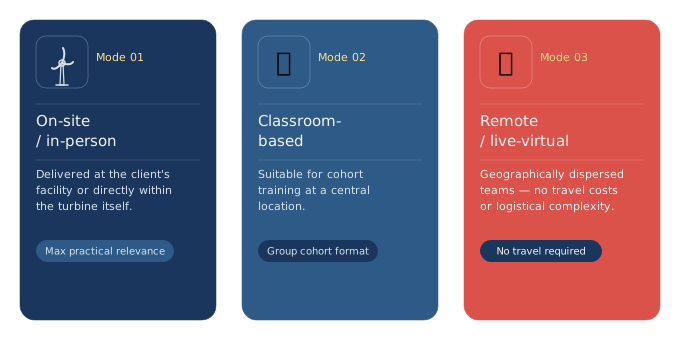
dwpa recognizes that training must fit around operational schedules, not the other way around. Programs are available across three delivery modes:
- On-site / in-person, delivered at the client’s facility or directly within the turbine itself, ensuring maximum practical relevance.
- Classroom-based, suitable for cohort training at a central location.
- Remote / live-virtual, enabling geographically dispersed teams to access high-quality instruction without travel costs or logistical complexity.
This flexibility means that organizations can build training programs that meet their workforce’s needs without compromising operational availability.
The Business Case for Training Investment
The argument for investing in structured wind turbine training is ultimately a financial one. Higher technician competency translates directly into faster fault resolution, fewer avoidable failures, better preventive maintenance execution, and longer component life; all of which improve energy production and reduce costs.
dwpa’s own performance calculator tool illustrates this vividly: even a 0.43% gain in production hours, achieved through improved operational performance, can represent significant revenue across a wind farm’s lifetime.
The client feedback dwpa has gathered consistently echoes this logic. An operations director at Realise Energy Services reports immediate, measurable improvement in field performance following training completion, with technicians applying their learning to resolve real hydraulic faults on their very first return to site. A wind turbine engineer with 13 years of experience describes still learning something new every single day during a dwpa course. An offshore Training Lead at SSE Renewables notes the dramatic difference between dwpa’s in-depth, tailored approach and the standardized training typically available elsewhere.
Conclusion
dwpa occupies a distinctive position in the wind energy training landscape: deep enough in technical expertise to be credible with experienced engineers, broad enough in its program portfolio to support every role in an operational organization, and flexible enough in its delivery model to serve clients from offshore wind farms in the North Sea to onshore sites across the Americas.
For wind farm owners, operators, and service providers seeking to improve the performance of their assets through the development of their people, dwpa represents a compelling and proven partner. With over 20 years of experience, a comprehensive curriculum that spans assessment through to advanced inspection, and a commitment to learning that translates into results on the job, the academy makes a persuasive case that the most durable competitive advantage in wind energy is not the turbine; it is the person operating it.
Ready to get started?
We work tirelessly to make sure that your performance will be enhanced via your interaction with us. If you are ready to start your operational performance improvement journey let’s get started!
